When Insight Moves Faster Than Authority
Organizations have never had more insight into their markets. Yet their ability to turn those signals into binding decisions has not kept pace.
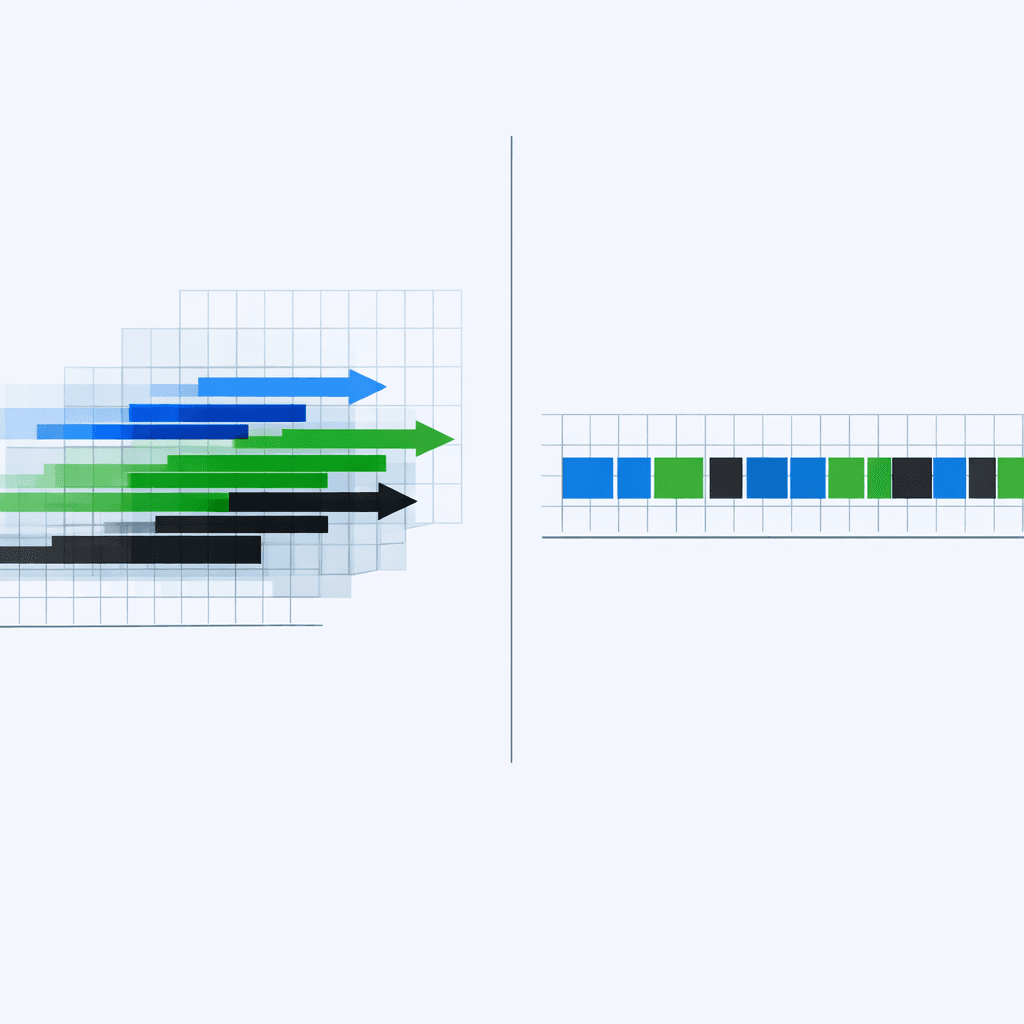
Across many organizations, a reassuring belief persists: that the primary challenge posed by AI, analytics, and market intelligence is technological.
The reality is less comfortable.
AI does not first transform how analysis is produced.
It transforms the precise point at which responsibility begins — and where it stops.
Seeing earlier has never been easier

Advanced analytics, digital signals, enriched CRMs, and generative AI now allow companies to detect market shifts with unprecedented precision.
Slowing segments. Price pressure. Changing buyer trade-offs. Competitive weak signals. Much of it is visible — often very early.
The time to insight has collapsed.
But a second, far less visible clock has barely moved:
the time it takes for an organization to recognize a signal as a legitimate trend — and act on it.
In other words, time to trend remains deeply organizational.
And this is where the paradox emerges.
According to Forrester, only 6% of B2B organizations can be considered truly insight-driven — capable of translating insight into coherent, enterprise-level decisions.
Strategic decisions themselves do not accelerate.
They are deferred, fragmented, or pushed downstream — sometimes until the market decides in the organization’s place.
This is not a visibility problem.
It is an activation problem.
The widening gap between insight and decision
Multiple studies point to the same conclusion:
most organizations produce insights they never fully use.
The reason is not uncertainty.
It is organizational design.
Gartner estimates that misalignment between marketing and sales costs B2B organizations 10–15% of annual revenue.
This loss does not reflect a lack of ideas, but a failure to translate signals into clear trade-offs: priorities, pricing, resource allocation.
As insight volumes grow, decision-making becomes politically more expensive.
Because deciding is no longer about “approving an analysis.”
It is about making a choice visible — and owning its consequences over time.
The CMO’s ambiguous role in the insight economy

This inertia becomes tangible in the position of the Chief Marketing Officer.
Today, the CMO is often the organization’s primary market sensor.
Marketing sees first:
shifts in customer behavior,
erosion of value propositions,
segment fatigue,
emerging pricing trade-offs.
In short, marketing is where insight arrives early.
But it is also where it often stops.
In most organizations, the CMO does not own pricing, commercial priorities, enterprise-level budget allocation, or product roadmaps.
Marketing produces analyses, narratives, and recommendations — without controlling the levers required to turn signals into binding decisions.
The paradox is striking:
as marketing becomes more data-driven, it is increasingly confined to an advisory role.
This is not a failure of individuals or skills.
It is a deliberate organizational design choice.
What AI changes — and what it does not
AI does not create this problem.
It intensifies it.
McKinsey reports that only 1% of companies consider themselves mature in their use of AI, despite massive investment.
Analytical production has accelerated. Decision-making has not.
Organizations are not short on insight.
They are short on places where insight forces a decision.

Three questions B2B CEOs should ask themselves honestly
Which market signal have we acknowledged — without changing our commercial priorities or pricing?
Which critical go-to-market decision currently has no clearly accountable owner?
Which decision debated at the executive table for months has yet to move pipeline, budgets, or resource allocation?
These are not questions about analytical quality.
They are questions about decision authority.
Conclusion
In the age of AI, the challenge is no longer generating more insight.
It is ensuring that insight does not become an excuse for inaction.
When signals are clear but authority is diffuse, organizations do not decide — they comment.
And markets always decide faster than committees.
